
Asa Haraldsdottir of Agder was a legendary Norwegian queen of the petty kingdom of Agder. Asa was the daughter of King Harald Granraude of Agder. She was born in the 8th century and died around 834 CE. She is reputed to be the woman buried in the famous Oseberg ship. The ship was discovered in a burial mound near Tonsberg, Norway, in August 1903. It was excavated in 1904-1905. 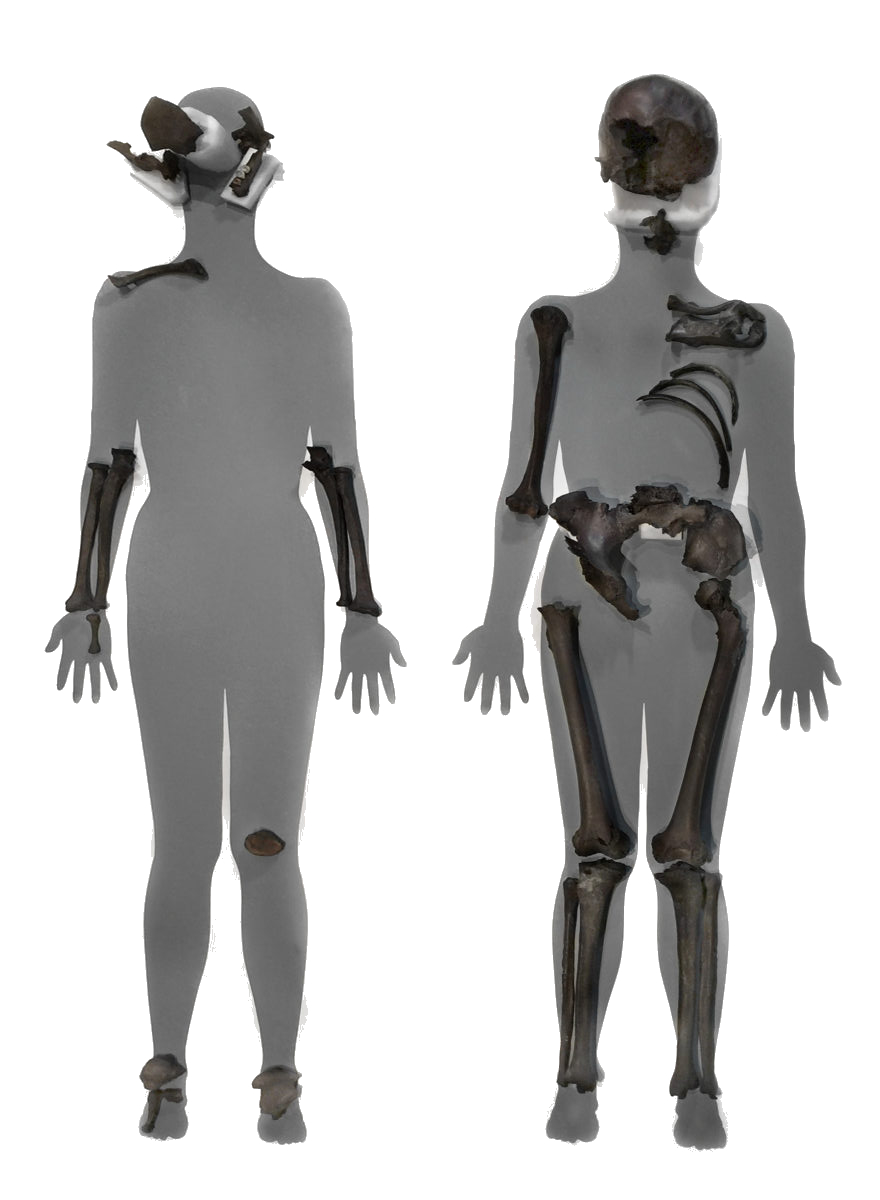
According to the Ynglinga saga by Snorri Sturluson, Asa was the mother of Halfdan the Black, grandmother of King Harald Fairhair and mythological hero Ragnar Lothbrok. Since my family can trace our lineage to King Harald Fairhair through the sagas, Queen Asa is our ancestor.
King Gudrod the Hunter of Borre in Vestfold proposed marriage to her after the death of his first wife. His proposal was refused by her father. Infuriated, Gudrod sailed with his ships to Harald’s farm on Tromoya. He made a surprise attack at night and killed Asa’s father and her brother. King Gudrod looted the farm and Harald’s treasure, raped Asa, and took her back with him to Borre. Halfdan the Black (c. 810-c. 860) was born of their union.
Two years later, when Halfdan was a year old, Asa’s servant assassinated Gudrod by a spear-thrust when he was drunk and returning from a feast. Asa admitted the servant acted on her behalf. She took her son and returned to Agder, where she ruled for 20 years. After this, she left the throne to her son, who also demanded half of his father’s kingdom from his half-brother, King Gudrod’s older son with his first wife.
The Oseberg ship, it’s human remains and contents, has been studied and speculated about for over a century. The remains of two women lay in a matrimonial bed. One was aged between 70 and 80, the second about 50. Were they lovers? Mother and daughter? Mistress and servant? Volva and chief singer? There is not enough DNA to tell if they were related, so their relationship is completely unknown. Both women were a little over five feet tall. Recent tests of the remains indicated that they lived in Agder, as did Queen Asa. The magnificently carved ship and its contents suggest that it was a burial of a person of exalted status. The Oseberg ship was built in western Norway around 820 CE. It is made of oak, with deck and mast of pine. Dendrochronological analysis of the timbers dates the burial to autumn 834 CE.
A burial chamber was built right behind the ship’s mast. The two women were laid out in a bed made of large down quilts. A tapestry was placed in the chamber. They were surrounded by a large quantity of other grave goods, including elaborately carved wooden sleighs, wagons, chests, silks, household and farming tools, personal goods, and mostly famously, the “Buddha bucket,” a yew bucket with a seated enameled figure that was most likely Celtic in origin. Another bucket made of yew, brass and bronze was found with six or seven wild apples still inside. There is a possibility that six other people were buried with the two women. This runic inscription: “Sigrid owns (this bucket)” is carved on a wooden bucket. Whether it belonged to one of the women found on the bed, or one of the sacrificial victims is unknown. In the 960s the Osberg ship was looted. Most bones were scattered or removed and jewelry stolen. The bones of 15 horses, 4 hounds, an ox, several cows and possibly pigs were found. They had been beheaded as sacrifices. 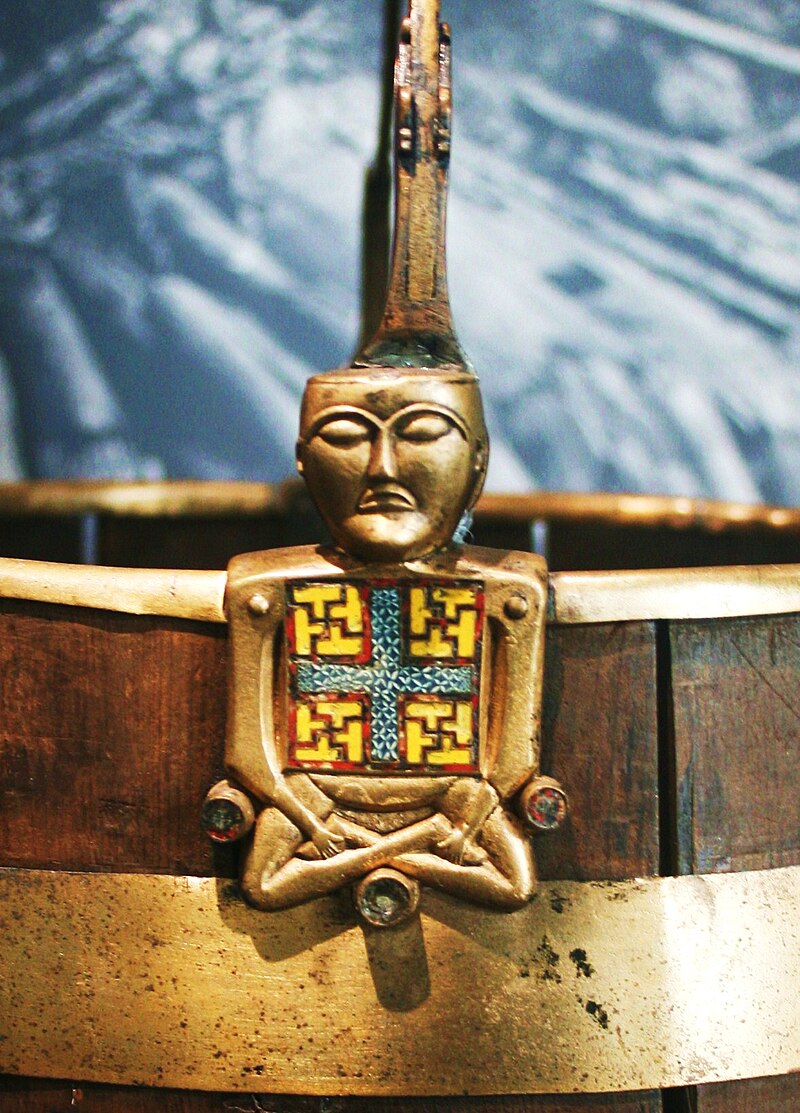
The body of the oldest woman was left intact. Although she lived to a very old age, she had suffered serious illness during her childhood and early youth. She died of cancer, either ovarian or breast cancer. Her bones were brittle and vertebrae were constricted. After reaching adulthood, she sustained an injury to her left knee that would have led her to limp. Her diet included a high proportion of meat rather than fish. She was laid out in a very fine red wool dress with a lozenge twill pattern and a fine white linen veil in a gauze weave. Small silk strips were appliqued onto a tunic worn under the red dress.
The younger woman who lay next to her was in good health when she died. She had a broken collarbone, but this injury had healed. Her teeth showed signs of wear consistent with her having used a metal toothpick—a luxury item. This suggested both women were of high status. She was dressed in blue wool, with a woolen headdress.
On the bed, was a leather pouch containing cannabis seeds. There was also a long staff, or distaff, which could be associated with the practice of seidr. Seidr was a Norse custom or practice of magic and prophecy.
Was the old woman buried in the Oseberg ship Queen Asa? Was she a volva? We may never know, but all the evidence suggests that she was a powerful ruler and spiritual figure.
The Oseberg ship is now at home in the Museum of the Viking Age in Oslo, Norway.
