
Lars Torkelsen Lindtveit was born about 1648. He died in 1710 at Lindtveit, Oyestad Parish, Aust-Agder, Norway. An extremely wealthy farm owner and timber baron, he appears to have been a very farsighted, shrewd, and calculating man.
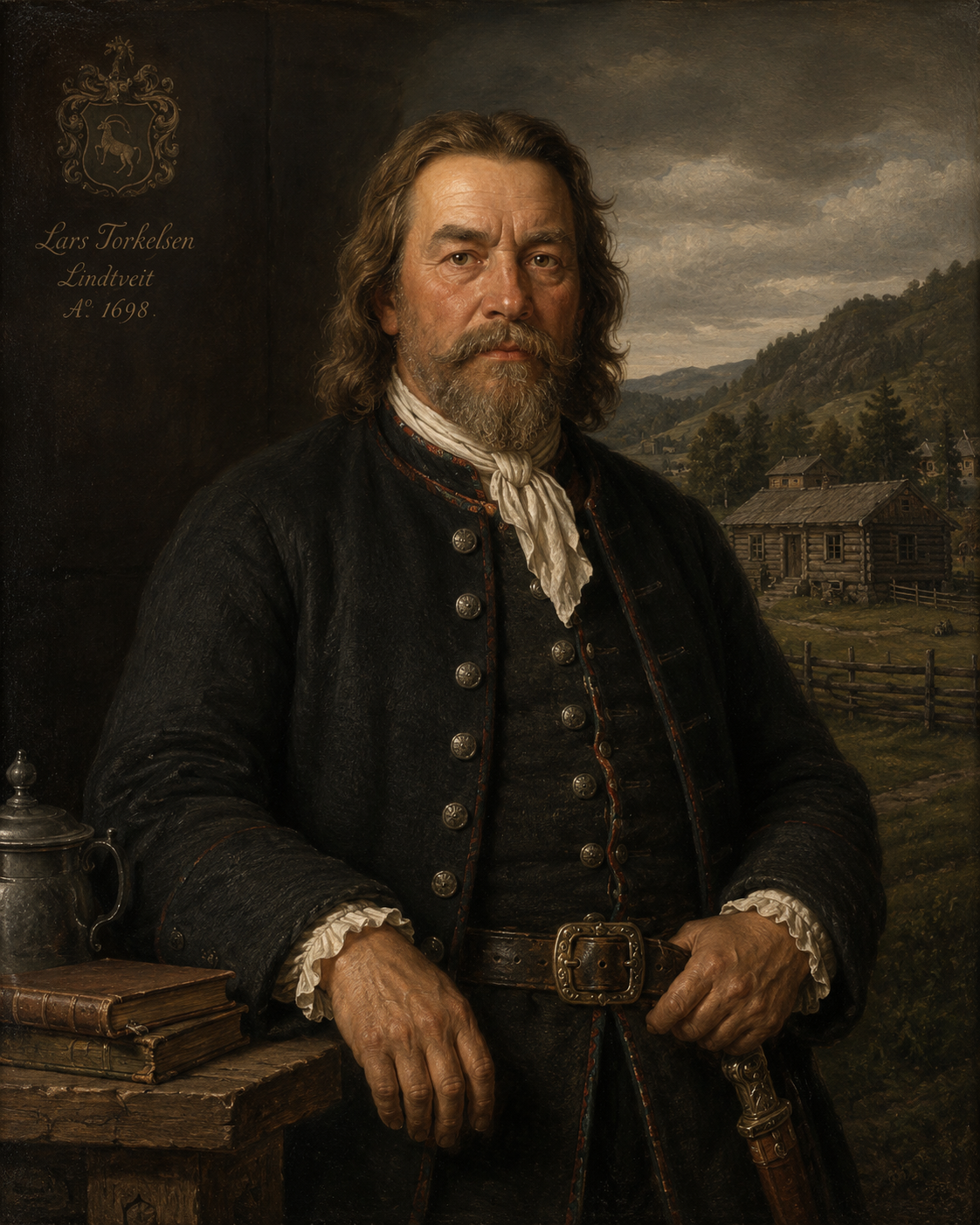
From the Oyestad Bygdebok: “Lars was a rich man who could only be compared to wealthy citizens in Kristiansand and Arendal. For many years he can a timber trade and money lending on a large scale. When a man could not pay his debt to Lars in money, he was allowed to deliver timber instead. If that didn’t work, Lars took a mortgage on the borrower’s property. Eventually, Lars had huge sums of money outstanding. In 1709, 21 farmers in Gjovdal owed a total of 780 dalers, 31 farmers in Amli owed 1,095 dalers. From 37 farmers in Mykland, Vegusdal, Herefoss, Landvig, Fjaere and Oyestad, Lars Torkelsen was owed 1,221 dalers. By mortgage, he had an interest in a number of farms.”
When he died in 1710, Lars Torkelsen left behind valuables worth over 7,200 dalers, an enormous amount at the time. His son, Soren, was a trading merchant and traveled on a ship that Lars held a quarter interest in. The share of the Lindtveit Farm was worth 1,000 dalers. At the farm, Lars had two horses, fifteen cows, six heifers, one ox, two sheep and five goats. He also had livestock on the neighboring farm, Steine, which he also owned. Apart from money and land, he left behind 500 dozen pine beams. He had them stored at Lindtveit, waiting for a time when prices would rise. The genealogist who researched the Andersen family for me remarked “You needed a good financial backbone for this!”
In the late 17th century, the wealthiest farmers in the Agder region were timber barons and merchants. They became rich by dominating the lucrative export of lumber to Dutch and British markets. They owned or controlled the sawmills, ships, and vast forest tracts. These “storebonder” (great farmers) were at the top of a highly stratified agrarian society. Wealthy farmers held allodial rights (odel), ensuring that property stayed within the family or clan lineage. In addition, they bought leasehold farms and became landlords. Since Norway lost its noble class after the medieval period, wealthy farmers held the highest social status in rural society. In our family, many were distant descendants of nobility, royalty and chieftains.
The name “Lindtveit” has old Norse roots. The name means “linden tree clearing,” suggesting that the land was settled as a small farm cut out of the dense forest by the Nidelva river. During the 16th to 18th centuries, the timber industry in Agder, Norway was the backbone of the region’s economy. Driven by international demand, especially from the Dutch and British, Aust-Agder transitioned from a subsistence-farming region into a major hub for European trade. The Nidelva River served as a vital highway for the timber industry. Loggers floated cut trees down the river to the sawmills and shipyards of Arendal. Timber trade brought a lot of economic activity to rural Adger, and powered Arendal’s rise as one of Norway’s largest trading centers. Most of the timber shipped out of Arendal went to the Netherlands and Scotland.
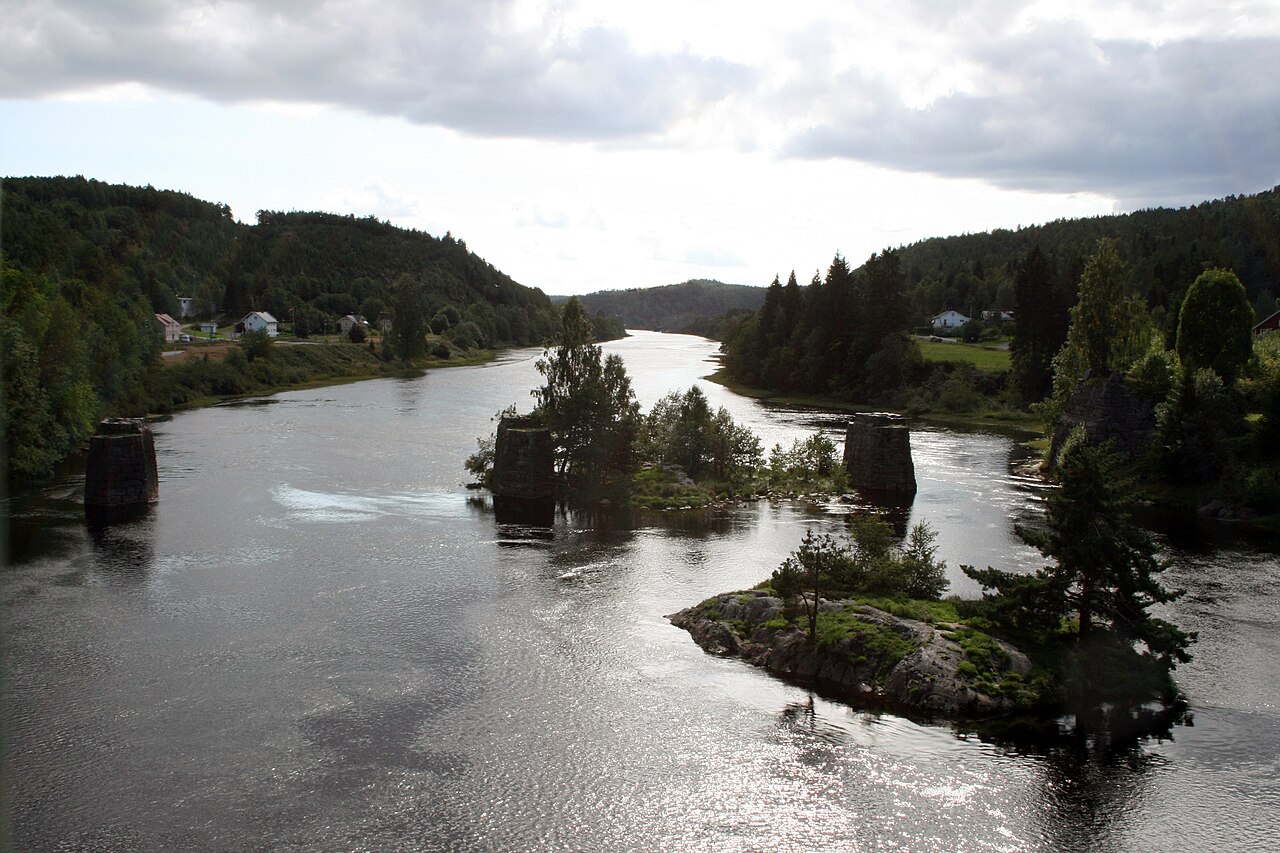
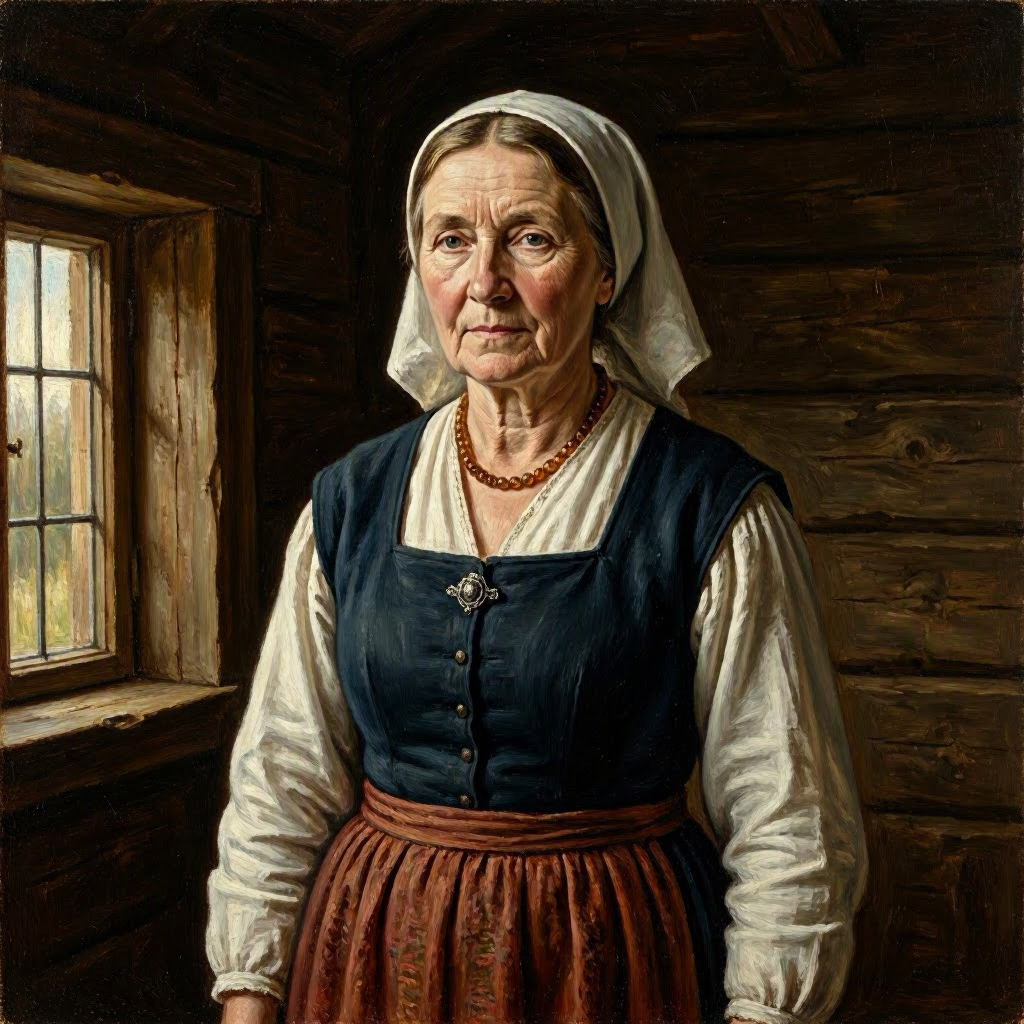
Lars Torkelsen married Marte Olsdatter Torvolt. She died in 1706 at Lindtveit, Oyestad Parish, Aust-Agder, Norway. She was the granddaughter of Peder Andersen Lindtveit. With her patrimonial right, Lars gained access to the farm. He eventually bought out the co-owners and got a deed to the property. In 1709 he owned over three hud in Lindtveit.
Lars and Marte had at least seven children. Their oldest son, Torkel Larsen Lindtveit was born around 1671 and died in 1729. He married twice and had children with both wives. Their children included Ole Larsen Lindtveit (born c. 1673); Christen Larsen Lindtveit (c.1675-1709); Karl Larsen Lindtveit (1678-1710), Soren Larsen Lindtveit (October 1684-1712); Ingeborg Larsdatter Lindtveit (my ancestor – c. 1687-c.1738); and Anne Larsdatter Lindtveit (born 1690).
Ingeborg Larsdatter Lindtveit was christened on 16 October 1687 in Oyestad Parish. She married Jorgen Olsen Hurv/Oveland before 1706. They had at least four children. Based on her probate record dated 2 February 1738, she probably died in Oveland, Aust-Agder during January 1738. She may have died earlier.
Lars also took in an orphan, Karen Andersen Stenelien, who may have been a relative of his wife. According to the Oyestad Bygdebok, he “raised her with food, clothes and Christian discipline.” The girl was in poor health, and a lot of money was spent on her medical care. Some of his attention may have come from Christian charity or to support a relative of his wife. Most likely, it was self-interest, and a means to control little Karen’s patrimonial inheritance right to Anders Pedersen’s interest in Lindtveit.
Lars Torkelsen Lindtveit and several of his sons died within a few years of each other. Lars Torkelsen died in 1710; his sons, Christen Larsen in 1709; Karl Larsen in 1710; and Soren Larsen in 1712. The death dates for one of his daughters and the oldest son are unknown. My guess is Lars and his sons died in the Great Northern Plague Outbreak which occurred between 1708-1712. It was a pandemic that swept through the Baltic Sea area. Since Lars and his family were engaged in trade and shipping, it is quite possible that they were exposed in Arendal or at sea by people who had traveled in the Baltic Sea region, including Prussia and Sweden, and who carried the plague home to Lindtveit.
Lara Torkelsen Lindtveit and his wife, Marte Olsdatter Torvolt, were buried inside the original Oyestad church. This honor cost him 20 dalers. After he died, the Lindtveit farm was divided between his two oldest sons, Torkel and Ole. Torkel got the main farm, and Ole got “10 ksk av Karlsbruket.”
The vast fortune had mostly dissipated by the time my 7th great grandmother, Lars Torkelsen’s granddaughter, Marte Jorgensdatter Oveland, grew up and married. She was born in November 1706 at Oveland, Oyestad, Aust-Agder to Jorgen Olsen Hurv/Oveland and Ingeborg Larsdatter Lindtveit. She married Skjolluf (also spelled Skieldulf) Pedersen Mjavatn in 1732 in Froland parish. They had at least eight children. She died on April 2, 1765 in Mjavatn, Froland, Aust-Agder, according to her estate probate records.
On the probate for Marte in February 1730, 6 cows, 6 heifers, 4 goats, 3 chickens, 5 sheep and 3 four-year-old sheep were registered. Of silver, she and Skjelluf had a silver staup with the letters SIS BKD and one with the letters HPSM. A “staup” (sometimes spelled staup) is a traditional Norwegian drinking cup or vessel, often featuring ornate hand-engravings, hand-painting, or delicate filigree work. These silver vessels—frequently used as wedding or bridal cups—were symbols of social status and hospitality. There were also seven silver spoons, two of which had his father’s marks and the year 1681. When the probate was conducted for Skjelluf in 1765, the estate was bankrupt. Their son, Soren, continued to live there and eventually bought the farm from the creditors.
Silver spoons must be an heirloom item in my family. My great grandfather, Carl Andersen, a descendant of Lars Torkelsen, gave silver spoons to his two oldest grandchildren – Carl Anderson and Florence Anderson. Edith Leach, the wife of Andrew Andersen, the nephew of Carl Andersen, gave my mother two silver spoons for my sister and me. One of them was lost over the years but the other remains. It is definitely Norwegian and may date to 1850 or earlier. It is a treasure, and tangible link to the past.
